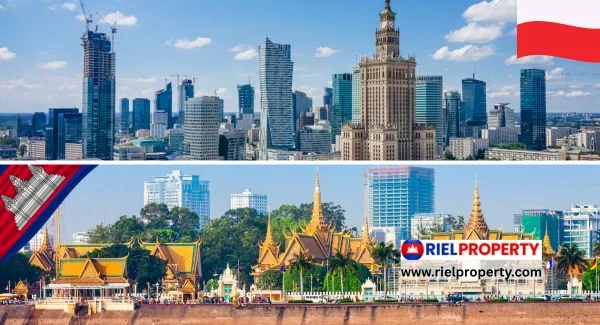
Polish investors have a problem that most financial advisers would call a good one. After years of strong GDP growth averaging close to 4% annually, a generation of Polish capital holders has arrived at a crossroads: domestic property yields that barely justify the effort, EU regulation tightening around digital assets under MiCA, and crypto portfolios that have compounded through multiple bull cycles into genuinely significant sums. The question is no longer how to make money. It is where to put it next.
Cambodia keeps coming up. Not through glossy developer roadshows or speculative hype, but through the kind of peer-to-peer research that spreads when early movers report back with actual numbers. A freehold condo in central Phnom Penh, yielding 7% gross in US dollars, bought with USDT profits for €60,000, sitting outside the EU regulatory perimeter entirely. For a Polish investor who already owns a Warsaw apartment, grinding out 3.5% and watching MiCA reporting requirements tighten, that combination lands differently than it would have five years ago.
At a Glance: Poland vs. Cambodia Property Investment
| Factor | Poland (Warsaw) | Cambodia (Phnom Penh) |
|---|---|---|
| Price per sqm (central) | ~€3,300–3,700 | $1,600–$3,000 USD |
| Gross Rental Yield | 3–5% | 6–8% (up to 10% coastal) |
| 1BR Entry Price | €200,000+ | From $45,000–$80,000 USD |
| Transaction Currency | PLN / EUR | USD (fully dollarised) |
| Foreign Ownership | EU nationals: unrestricted | Freehold strata title (condos) |
| GDP Growth (2025 est.) | ~3–4% | ~5–5.5% |
| Regulatory Perimeter | EU, MiCA, tightening AML | Outside EU jurisdiction |
Jump to: Crypto to Property | MiCA and EU Regulation | Yield Comparison | Guaranteed Returns Warning | Where to Buy | Risks | FAQ
The Crypto-to-Property Transition: Why Cambodia Fits
Poland produced an unusually active retail crypto investor base relative to its size. Surveys consistently show that a majority of Polish investors now treat digital assets as a standard portfolio component, not a fringe speculation. That normalisation matters because it means a large cohort of Polish holders entered the market early, compounded through multiple cycles, and now holds positions that have grown well beyond what they originally risked.
The question those investors face is universal among successful crypto allocators: at what point do paper gains become real wealth? The standard answer is converting into hard assets, and real estate is the most common destination. The problem in Poland, and across Europe generally, is that the obvious choices, Warsaw, Kraków, Berlin, are expensive in absolute terms and yield very little. A Polish investor who converts €80,000 of Bitcoin gains into a Warsaw studio gets a 3.5% gross yield if they manage it well. The same €80,000 invested in a central Phnom Penh condominium, bought in USD off the back of a USDT-to-fiat conversion, yields a fully furnished, freehold unit in a growing capital city, worth twice that figure.
The dollarisation of Cambodia’s property market makes this transition particularly clean. Every stage of a Cambodian condo transaction, from the Sale and Purchase Agreement to the rental contract to the eventual resale, runs in US dollars. An investor converting USDT to USD on a regulated exchange before wiring funds via SWIFT to a Cambodian developer account faces a single conversion step and ends up holding a dollar-denominated asset on the other side. No further currency exposure. No PLN volatility. No EUR exchange risk. The Riel Property investor guides walk through the compliant payment process in full, including how to structure a crypto-sourced purchase through documented USD channels.
MiCA, EU Regulation, and the Geography of Capital
MiCA, the EU’s Markets in Crypto-Assets regulation, came fully into force in December 2024. It mandates licensing for crypto service providers, standardises reporting requirements across all member states, and extends AML oversight more deeply into the digital asset space than any previous EU framework. Poland, as an EU member, sits squarely within its scope.
Most Polish investors are not trying to evade these rules. The point is more subtle than that. When every asset in a portfolio falls within a single regulatory jurisdiction, the portfolio carries a concentration risk unrelated to market performance. EU-wide policy shifts, tax harmonisation discussions, capital controls in extreme scenarios, and evolving reporting obligations all affect EU-held assets simultaneously. Holding a portion of total wealth in a different jurisdiction, in a different currency, under a different legal framework, is a standard diversification approach that is not inherently problematic.
Cambodia sits entirely outside the EU perimeter. A Cambodian freehold condo title held in an individual’s name, transacted in USD, and managed under Cambodian law, is not subject to MiCA reporting, EU AML directives, or any future EU property-related regulation. That separation is precisely what internationally minded Polish investors are seeking when they talk about geographic diversification.
The Yield Gap in Numbers
Cambodia over European alternatives comes down to one table.
| Market | Avg. Gross Yield | Est. Net Yield | Price per sqm | 1BR Entry Price |
|---|---|---|---|---|
| Warsaw | 3–5% | 2–3.5% | €3,300–3,700 | €200,000+ |
| Berlin | 2–3% | 1–2% | €6,000–10,000 | €350,000+ |
| Paris | 2–3% | 1–2% | €10,000–15,000+ | €500,000+ |
| Phnom Penh (BKK1) | 6–8% | 4.5–6% | $2,650–3,000 | From $130,000 |
| Phnom Penh (BKK3) | 6–8% | 4.5–6% | $1,600–2,200 | From $45,000 |
| Sihanoukville (beachfront) | 8–10% projected | 6–8% | $1,200–2,200 | From $40,000 |
A Polish investor deploying €80,000 into a Warsaw studio targets roughly €2,400 to €2,800 in net annual income. The same capital into a well-chosen BKK3 condo in Phnom Penh targets $4,800 to $6,400. Over a ten-year hold, the cumulative income difference is material, and that gap exists before accounting for Cambodia’s stronger GDP growth trajectory and the capital appreciation potential of a market still well below its long-term pricing ceiling.
The Guaranteed Returns Problem: What Polish Investors Need to Know
Search for Cambodia property online, and guaranteed rental returns of 8% to 10% appear everywhere. They look attractive, especially to a first-time foreign buyer, compared to Warsaw’s 3.5%. Treat them with scepticism.
Here is how most guaranteed schemes actually work. The developer prices the unit above its genuine market value, effectively pre-paying the guaranteed yield through an inflated purchase price. The buyer receives their 8% for two to three years, believes the investment is performing well, and then the guarantee expires. At that point, the property earns whatever the open market will support, which often amounts to 4% to 6% of the actual price paid. The investor has not made 8% for three years. They have received a rebate on their own capital dressed up as a yield.
Experienced Polish investors know how to read through this because they apply the same logic they use at home. In Warsaw, nobody buys a buy-to-let based on a developer’s income projection. They check comparable rents on the same street, examine vacancy rates in similar buildings, and model what the property actually generates in the open market. That is exactly the right framework for Cambodia. Phnom Penh’s rental data is increasingly available and comparable. Investors who anchor their analysis on real district-level rental evidence rather than promotional guarantees make decisions that hold up over a full market cycle.
Riel Property’s investor guides present gross and net yield data in market-comparable format, with holding cost context and realistic vacancy assumptions, rather than the headline figures developers use to sell off-plan inventory.
Where in Cambodia to Focus: A District-Level View
BKK1: Phnom Penh’s Prime Expat Address
BKK1 is where Phnom Penh’s embassies, international schools, premium restaurants, and the largest concentration of well-paid foreign professionals cluster. It produces the city’s most consistent rental demand and its strongest secondary market liquidity. Prices at $2,650 to $3,000 per square metre are higher than in other districts, but the tenant quality and exit flexibility that come with a BKK1 address justify the premium for investors who prioritise reliability over maximum yield-on-cost.
Le Condé 2 represents the top tier of what BKK1 currently offers: a 60-storey luxury tower with the rental profile to match its address. Time Square 9 Gatsby brings the same location at pre-launch pricing, sitting 30% to 50% below completed BKK1 comparables, from $88,000, which is the more interesting entry point for investors who want BKK1 exposure without paying full completion premiums.
BKK3: The Yield Efficiency Play
BKK3 is five minutes from BKK1, borders the Russian Market area at Toul Tom Poung, and draws on the same tenant base at a materially lower entry price. For a Polish investor allocating €50,000 to €80,000 as a first Cambodia position, this is the district where the numbers work most cleanly. Time Square 11 starts at approximately $45,000 for a fully furnished freehold unit, with a 20% deposit at contract and 1% per month across 35 months of construction. June 2029 completion. Developer track record across nine-plus completed towers. This is the project that converts the theoretical case for Cambodia into a specific, actionable decision.
Tonle Bassac: Landmark Scale for Premium Buyers
Tonle Bassac has become Phnom Penh’s address for large-format luxury residential. J Tower 3 at 77 floors and 310 metres is the tallest residential building in the city, 70% sold at $1,853 per square metre, targeting 2028 completion. For Polish investors whose Cambodia allocation sits at the upper end of their budget and who want a building with genuine architectural distinction and hard title ownership, this is the Tonle Bassac option that warrants serious attention.
Sihanoukville: Coastal Returns for Investors Comfortable with Tourism Cycles
Sihanoukville is a different proposition from Phnom Penh, suited to a different investor mindset. The city experienced a dramatic Chinese-capital-driven cycle between 2016 and 2019, then corrected sharply. What remains is a legitimate beach destination with improving infrastructure, recovering tourism, and property prices reset to historically competitive levels. Time Square 10 on Otres Beach offers beachfront freehold condos from approximately $40,000, projected yields of 8% to 10%, and a developer with a clean completion record across Phnom Penh. Over 70% of units sold within weeks of launch. For Polish investors seeking tourism-driven upside alongside their urban allocation, Sihanoukville provides a coastal counterweight.
Three Polish Investor Profiles Currently Active in Cambodia
| Profile | Primary Driver | Typical Budget | Preferred Location |
|---|---|---|---|
| Crypto investor | Converting digital gains into hard USD assets outside the EU | $45,000–$150,000 | BKK3, central Phnom Penh |
| Remote entrepreneur | Lower operating base, income-producing asset, ASEAN access | $80,000–$200,000 | BKK1, BKK3, Toul Kork |
| International diversifier | 5–20% Southeast Asia allocation, yield uplift, geographic spread | $100,000–$300,000 | BKK1, Tonle Bassac |
Risks: The Unvarnished Version
Cambodia deserves its reputation as an attractive emerging market. It does not deserve a free pass on the risks. Here they are, plainly stated.
The market is illiquid compared to Warsaw. Selling a Phnom Penh condo takes longer, costs more in relative transaction terms, and depends more heavily on the specific building and district than selling an apartment in a European capital. Buyers who need the money back within two years have no business being in this market.
Developer quality varies enormously. Some builders in Cambodia consistently deliver projects on time and to specification. Others do not. The difference between a clean exit and a difficult ownership experience in this market often comes down entirely to which developer you chose and whether you checked their track record properly before signing.
Guaranteed rental schemes frequently disappoint. The risks here go beyond the purchase price inflation already covered above. If the developer running the guarantee hits cash flow problems, payments stop. If the building fills with similarly packaged units, resale becomes difficult because secondary-market buyers price based on real rents, not promotional ones. Investors who want genuine yield buy fairly priced stock in proven rental districts.
The 70% foreign ownership cap is a hard limit. Buyers who do not verify the remaining foreign quota in a building before signing can find themselves unable to register title cleanly. This is a due diligence step that must happen before reservation, not after.
Regulation is evolving. Cambodia’s legal and financial framework is improving, but it is still developing. Rules around digital asset payments, capital gains tax implementation, and property registration have all shifted in recent years and will continue to evolve. Buyers need current, professional advice, not information sourced from articles written eighteen months ago.
None of these risks makes Cambodia the wrong choice. They make it a choice that rewards preparation and penalises shortcuts.
Buying in Cambodia from Poland: The Practical Steps
The full purchase process is more manageable remotely than most Polish buyers expect. Research and shortlisting happen online. A small reservation deposit, typically a few thousand USD, holds the unit while legal review proceeds. A qualified Cambodian lawyer verifies the strata title, checks the foreign ownership quota, and reviews the Sale and Purchase Agreement before signing. Payments move via SWIFT from a Polish bank account directly to the developer’s corporate account in Cambodia, with official receipts issued at each milestone. Power of Attorney arrangements allow the entire process to be completed without the buyer needing to visit Cambodia until handover.
For Polish investors using USDT or other crypto as the funding source, the cleanest route is selling on a regulated, KYC-compliant exchange, converting to USD, and wiring fiat in a single SWIFT transfer. This produces a fully documented paper trail, a clean SPA in USD, and a registered title that withstands any future scrutiny. The crypto element sits entirely in the upstream funding history, not in the property transaction itself.
Why Work with Riel Property
Most property transactions in Cambodia end at the point of sale. The developer hands over keys and moves on to the next buyer. Riel Property is built on the opposite model, because a foreign investor who buys well, rents quickly, and holds profitably will come back. One who buys the wrong unit in the wrong building and struggles to find a tenant will not.
The practical difference shows up in the details. Riel Property advises on selecting specific units within each building, not just on project selection within the market. Floor level, stack position, view corridor, noise exposure, and proximity to lift shafts all affect rental appeal and resale value in ways that developer brochures never mention. For Polish buyers purchasing remotely, Riel Property coordinates the full transaction with trusted local lawyers and development teams, provides regular construction milestone updates for off-plan purchases, manages the handover process, including snagging, assists with furniture installation and tenant placement, and stays involved through the ongoing ownership cycle.
For Polish investors using crypto to fund their purchase, Riel Property can also accept USDT for applicable service fees where permitted, subject to standard KYC and compliance procedures.
Browse current listings across Phnom Penh and Sihanoukville at Riel Property’s property listings, and work through the investment context, ownership rules, and yield analysis in detail at the Riel Property investor guides.
Specjalna nota dla inwestorów z Polski
W obliczu wdrażania regulacji MiCA w UE oraz niskich stóp zwrotu w Warszawie (3-4%), dywersyfikacja portfela w Kambodży jest kluczowym wyborem.
Pomagamy w bezpiecznej konwersji kapitału na nieruchomości z tytułem własności (Hard Title), generujące zyski w USD poza jurysdykcją UE.
Dlaczego teraz? Kambodża odroczyła podatek od zysków kapitałowych do 2027 r. To najlepszy moment na inwestycje Off-Plan.
Frequently Asked Questions
Can Polish citizens buy property in Cambodia?
Yes. Polish nationals can own freehold strata-titled condominium units above the ground floor in Cambodia, provided the building’s 70% foreign ownership quota has capacity remaining. There are no nationality-specific restrictions. The title is registered in the buyer’s name.
What gross yields can Polish investors realistically expect in Phnom Penh?
Market-wide gross condo yields averaged approximately 6.8% to 7.7% across Phnom Penh districts in 2025. After management fees, maintenance, and a realistic vacancy rate, net yields typically land 1.5% to 2% below gross. Investors targeting 4.5% to 6% net on well-chosen, fairly priced stock in strong rental districts are working with realistic numbers.
Are guaranteed rental returns worth considering?
No, not without detailed independent analysis. Most guaranteed schemes embed the cost of the guarantee into an inflated purchase price. Once the guarantee period expires, actual market rents often yield lower returns than the promotional figure suggests. Focus on independently verifiable comparable rental data from similar buildings in the same district.
How do I use USDT to buy a Cambodia condo?
Sell USDT on a regulated, KYC-compliant exchange, convert to USD, and wire fiat via SWIFT to the developer’s corporate account or a lawyer’s client account. The Sale and Purchase Agreement and all title documentation use USD. The crypto sits in the upstream funding history only. All property records are clean, fiat-denominated, and legally sound.
How much does a condo cost in Phnom Penh in 2025 and 2026?
Prices range from approximately $1,600 to $3,000 USD per square metre, depending on district and specification. BKK1 sits at the upper end; central emerging districts like BKK3 sit at lower levels. A one-bedroom unit in a quality new-build typically falls between $60,000 and $180,000, depending on size, floor level, and building amenities. Entry-level units in BKK3 start from approximately $45,000.
How long does a purchase take from start to title?
A completed-unit purchase typically closes in four to eight weeks from reservation through to title registration. Off-plan purchases involve a longer payment schedule across the construction period, with title issued at completion. The legal and transfer process itself, once payments are settled, usually completes within a few weeks.

Thomas Kaspersky
I’m Thomas Kaspersky, specialising in property investment across several markets, including Cambodia, the UK, Dubai/UAE, and Poland. With experience as an engineer and project manager, I enjoy explaining how developments, construction, and market data shape real estate opportunities.
View all posts